Crows are intelligent, adaptable birds found in many parts of the world, from cities and farmland to forests, islands, and coastal areas. Although many species have mostly black feathers, types of crow can differ in size, bill shape, calls, habitat, behavior, and geographic range. Most belong to the genus Corvus within the family Corvidae, which also contains ravens and other related birds. In this guide, you will learn about recognized crow species, including their scientific names, appearance, distribution, habitat, diet, behavior, and conservation status. The guide also explains how crows differ from ravens and why some crow classifications can vary between taxonomic authorities.
What Is a Crow?
A crow is a bird in the genus Corvus. Crows belong to the family Corvidae, a group that also includes ravens, jays, magpies, and other corvids. The word “crow” is a common-name term rather than a single scientific rank, so different species can share the name even when they live thousands of miles apart.
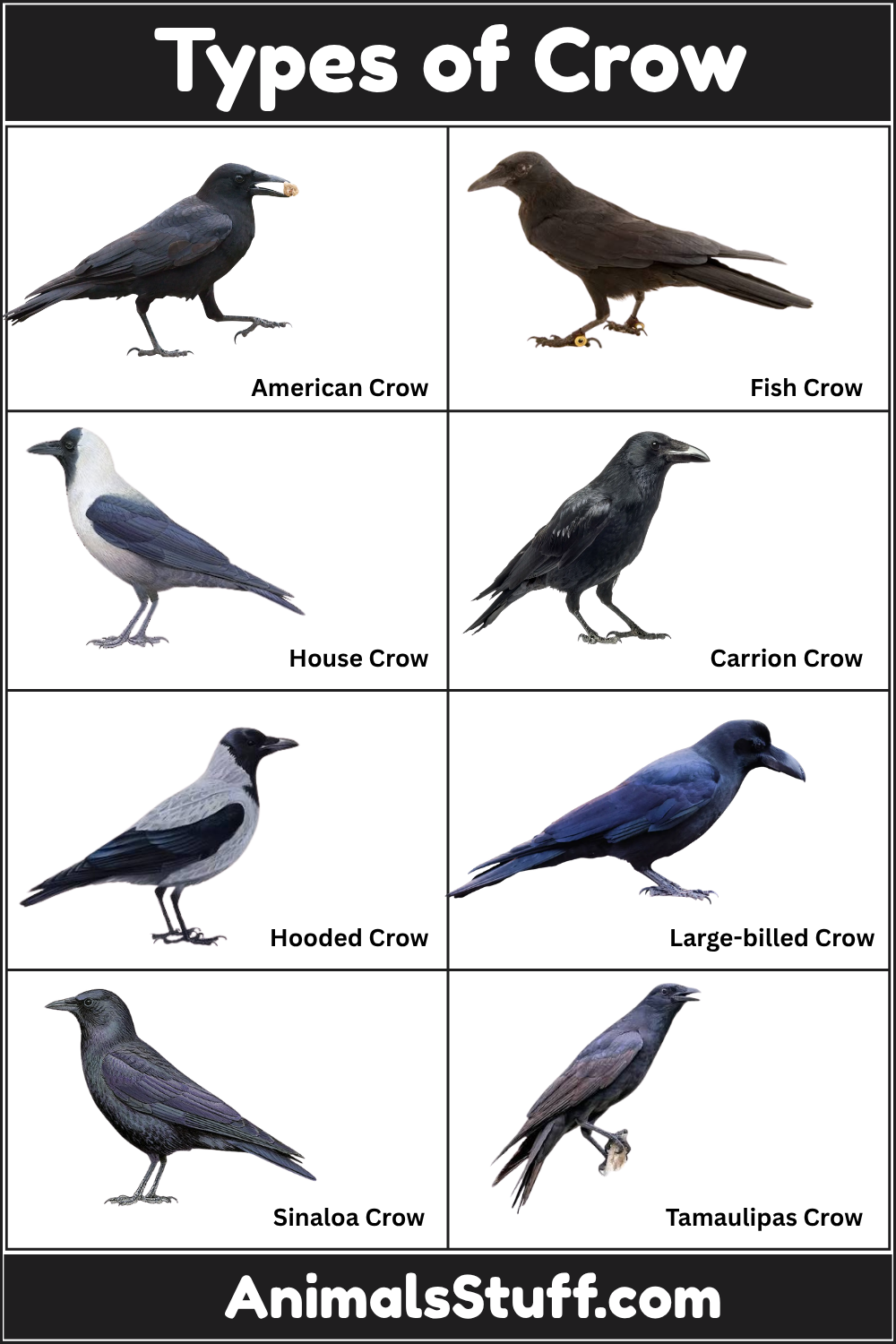
Different Types of Crow
| Name | US IPA | Short Description |
|---|---|---|
| American Crow | /əˈmɛrɪkən kroʊ/ | Widespread black crow of North America, commonly found in forests, fields, roadsides, towns, and cities. |
| Fish Crow | /fɪʃ kroʊ/ | Water-associated North American crow recognized especially by its nasal calls and adaptable feeding habits. |
| House Crow | /haʊs kroʊ/ | Slender urban crow with a grayish neck, strongly associated with human settlements and food waste. |
| Carrion Crow | /ˈkæriən kroʊ/ | Mostly black Eurasian crow that feeds opportunistically in farmland, woodland edges, towns, and open habitats. |
| Hooded Crow | /ˈhʊdɪd kroʊ/ | Distinctive gray-and-black crow found across northern and eastern parts of Europe. |
| Large-billed Crow | /ˌlɑrdʒˈbɪld kroʊ/ | Asian crow recognized for its large bill and broad distribution across forests, farms, and urban areas. |
| Sinaloa Crow | /ˌsɪnəˈloʊə kroʊ/ | Small glossy black crow endemic to northwestern Mexico, often living near towns and open habitats. |
| Tamaulipas Crow | /ˌtæməˈliːpəs kroʊ/ | Small glossy crow of northeastern Mexico known for its unusual frog-like croaking call. |
| Pied Crow | /paɪd kroʊ/ | African crow with contrasting black and white plumage, common across many open and human-modified landscapes. |
| Torresian Crow | /təˈriːziən kroʊ/ | Large Australian crow found across northern Australia and nearby islands, including urban environments. |
| Little Crow | /ˈlɪtəl kroʊ/ | Smaller Australian crow inhabiting dry inland regions, towns, cultivated areas, and surrounding open country. |
| New Caledonian Crow | /nuː ˌkælɪˈdoʊniən kroʊ/ | Island crow famous for making and using tools to obtain difficult-to-reach food. |
| White-necked Crow | /ˌwaɪtˈnɛkt kroʊ/ | Large Caribbean crow restricted mainly to Hispaniola, where forest habitat is important for survival. |
| Jamaican Crow | /dʒəˈmeɪkən kroʊ/ | Small Caribbean crow found only on Jamaica, closely related to several other West Indian crows. |
| Hawaiian Crow | /həˈwaɪiən kroʊ/ | Hawaiian island crow known as ʻAlalā, extinct in the wild and subject to ongoing recovery efforts. |
Types of Crow and Their Species
American Crow
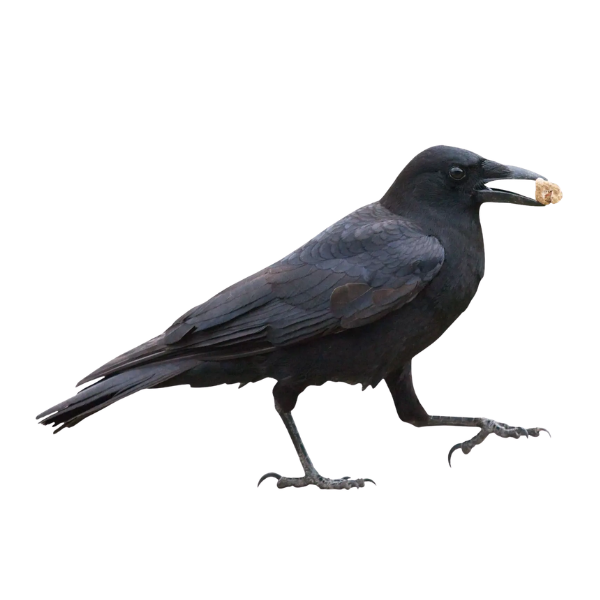
The American Crow is one of the best-known types of crow in North America. It is a large, all-black bird with a strong bill and a distinctive cawing voice. It occurs in open woodlands, fields, beaches, roadsides, parks, and urban areas across much of the continent. Its diet is extremely varied and includes insects, earthworms, seeds, fruit, carrion, garbage, and other small foods. American Crows commonly forage on the ground and may gather in large communal roosts.
Fish Crow
The Fish Crow is a North American species commonly associated with shorelines, rivers, lakes, wetlands, and other areas near water. It looks very similar to the American Crow, so its voice is often the most useful identification clue. Its calls are more nasal and distinctive than those of the American Crow. Fish Crows are social and highly adaptable feeders that eat a wide range of foods.
House Crow
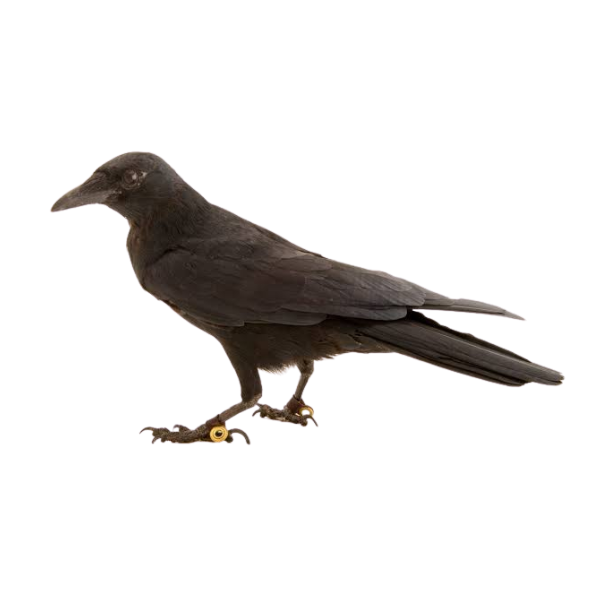
The House Crow is a slender, medium-sized crow strongly associated with people. It has a glossy black head, wings, tail, and body, while the neck and nape are noticeably grayish, creating a contrasting collar. It is native to South Asia and has also become established in other regions, often through human-assisted movement and shipping. House Crows commonly live around towns, cities, markets, ports, roads, and other developed places.
Carrion Crow
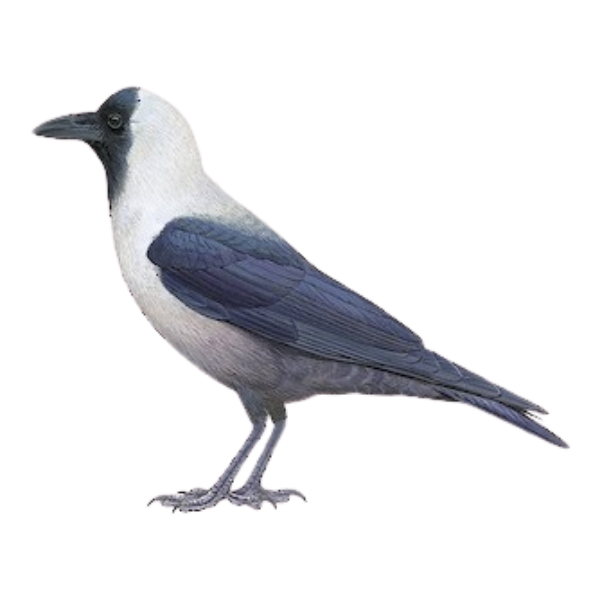
The Carrion Crow is a mostly black crow associated with Europe and parts of Asia. It has glossy dark plumage, a strong bill, and a compact appearance. Like many crows, it has a flexible diet that can include insects, seeds, fruit, small animals, carrion, and food associated with people. Carrion Crow is generally treated as a species in major bird references, although its relationship with the Hooded Crow has produced different taxonomic treatments over time.
Hooded Crow
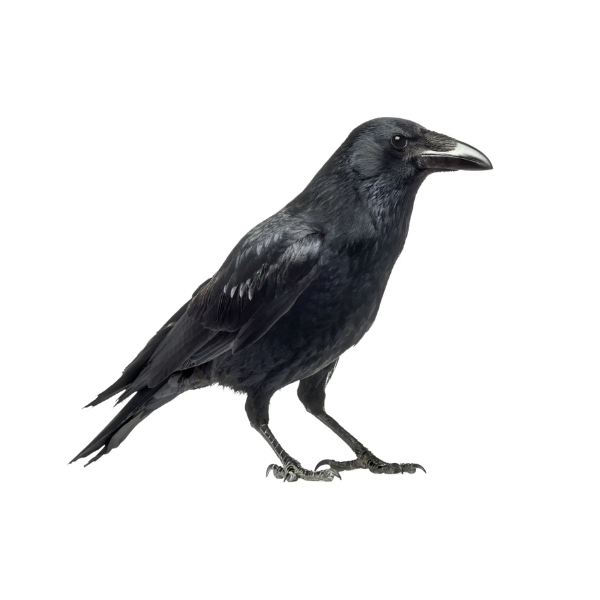
The Hooded Crow is particularly easy to recognize because most of its body is gray while its head, throat, wings, and tail are black. It occurs across northern, eastern, and southeastern Europe and extends into parts of the Middle East. Hooded Crows use farmland, open countryside, woodland edges, towns, and other suitable habitats. Taxonomic authorities differ in how closely they treat the Hooded and Carrion Crow, so this distinction should be stated when publishing species lists.
Large-billed Crow
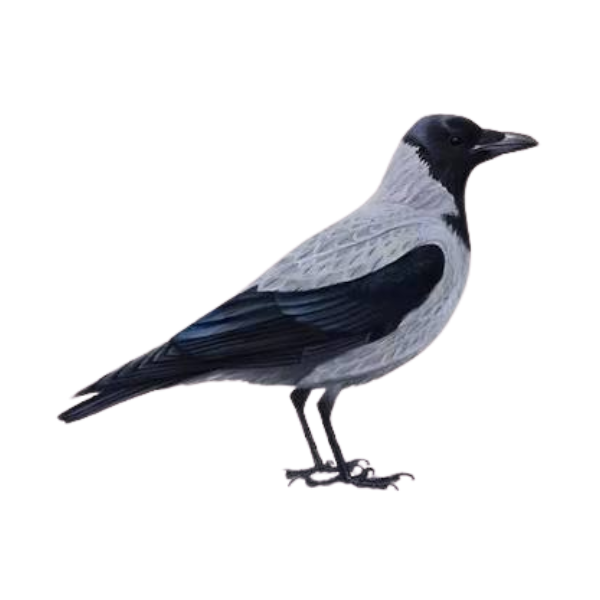
The Large-billed Crow is a widespread Asian crow recognized by its powerful, relatively large bill. It has mostly black plumage and occurs in a variety of habitats, including woodland, farmland, open countryside, villages, and urban areas. The scientific classification of large-billed crow populations has changed as researchers have examined vocal, genetic, and morphological differences.
Sinaloa Crow
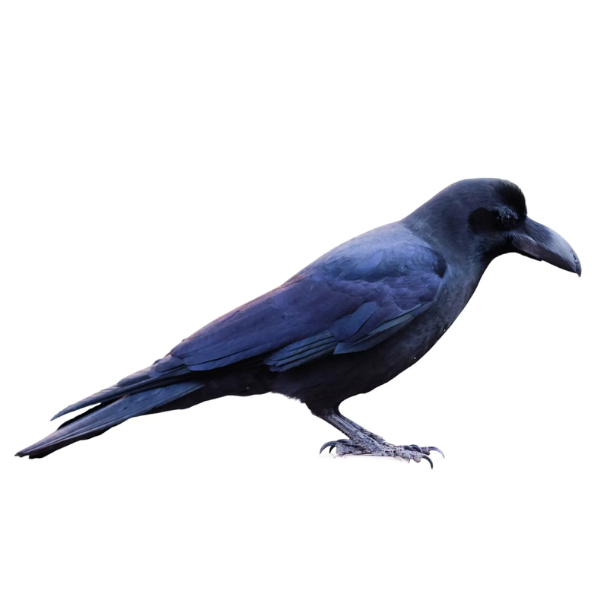
The Sinaloa Crow is a small, glossy black crow endemic to northwestern Mexico. It commonly occurs around towns, villages, farmland, rubbish dumps, semi-open country, hedges, and taller trees. It can also be found near water and may form large roosting groups. The species has a social lifestyle outside breeding periods and feeds opportunistically. Its range is centered in Mexico rather than extending widely across North America.
Tamaulipas Crow
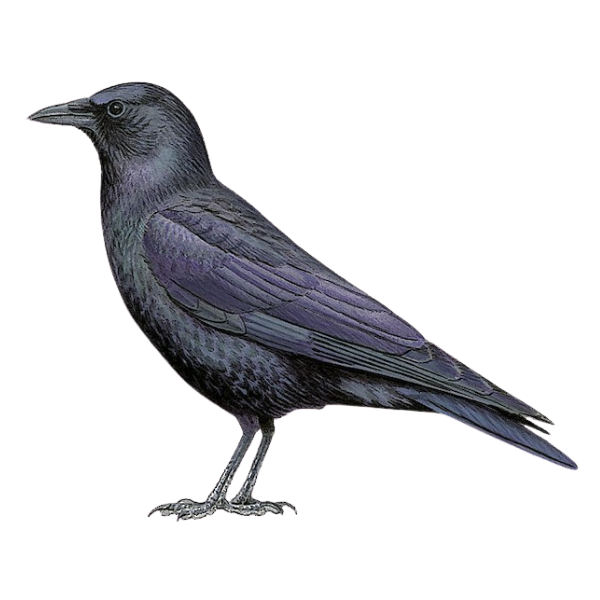
The Tamaulipas Crow is a small, glossy crow found mainly in northeastern Mexico, with occasional records in southern Texas. It uses open areas, farmland, ranches, villages, scrub, and other semi-open habitats. Its distinctive croaking call is an important identification feature. It is social outside the breeding season, although comparatively little is known about some aspects of its breeding biology. 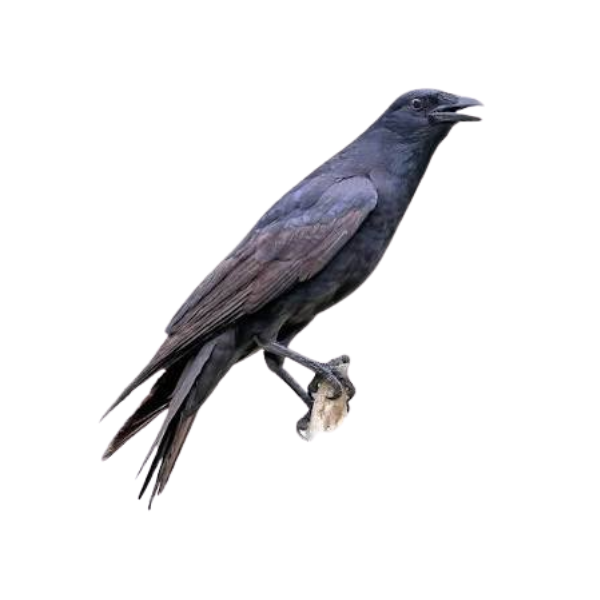
Pied Crow
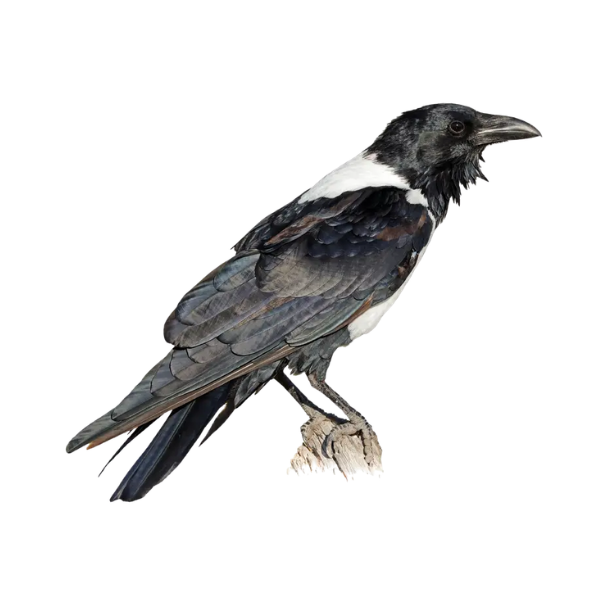
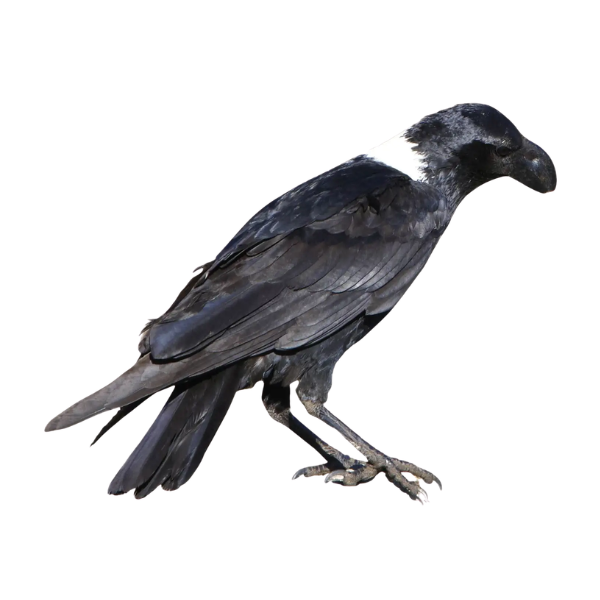
The Pied Crow is a widespread African species with striking black-and-white plumage. Its black head, wings, and back contrast with a broad white area across the neck and breast, making it different from many completely black crows. It is roughly crow-sized but has some features that make it look intermediate between typical crows and ravens. Pied Crows occupy many open habitats, including savannas, farmland, towns, and other human-modified areas.
Torresian Crow
The Torresian Crow is a large glossy black crow found across northern Australia and nearby islands, including parts of Indonesia and Papua New Guinea. It occurs in woodland, forest, rainforest edges, coastal areas, farmland, and cities. Its diet includes grain, fruit, insects, eggs, carrion, garbage, and other available foods. It commonly builds bulky stick nests high in trees or sometimes on artificial structures such as power poles and pylons.
Little Crow
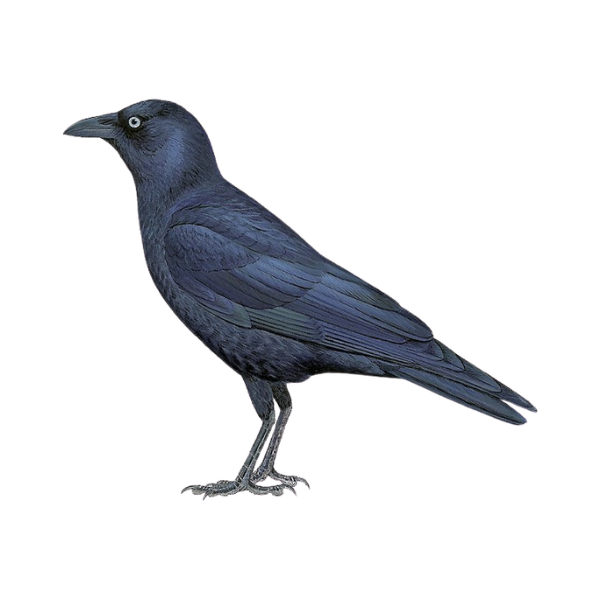
The Little Crow is a smaller Australian crow that lives mainly in western and central Australia. It is similar in appearance to the Torresian Crow but is smaller and has a somewhat smaller bill. Its habitat includes dry inland country, near-desert environments, small towns, cultivated land, and open areas. Unlike the more scavenging Torresian Crow, the Little Crow relies less heavily on scavenged food.
New Caledonian Crow
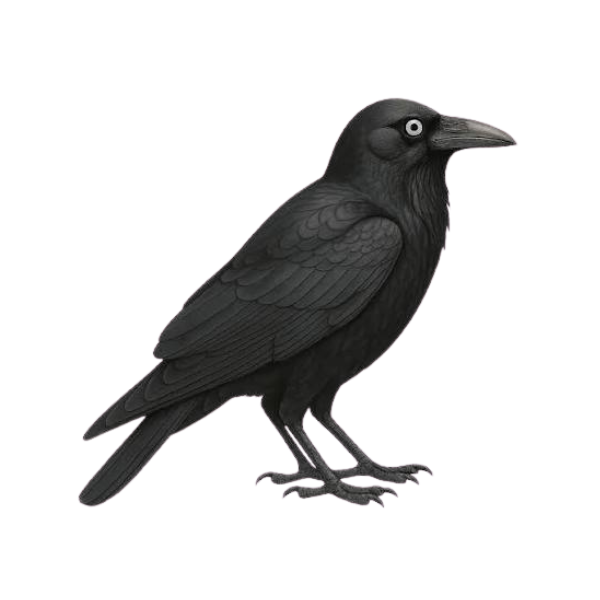
The New Caledonian Crow is an island species native to New Caledonia and is particularly famous for its tool-using behavior. It has glossy black plumage and a distinctive bill whose lower edge gives it a somewhat unusual profile. It eats insects and other invertebrates as well as eggs, small animals, snails, nuts, and seeds. Some individuals use sticks and other plant materials to extract difficult-to-reach prey, and the species can manufacture specialized tools.
White-necked Crow
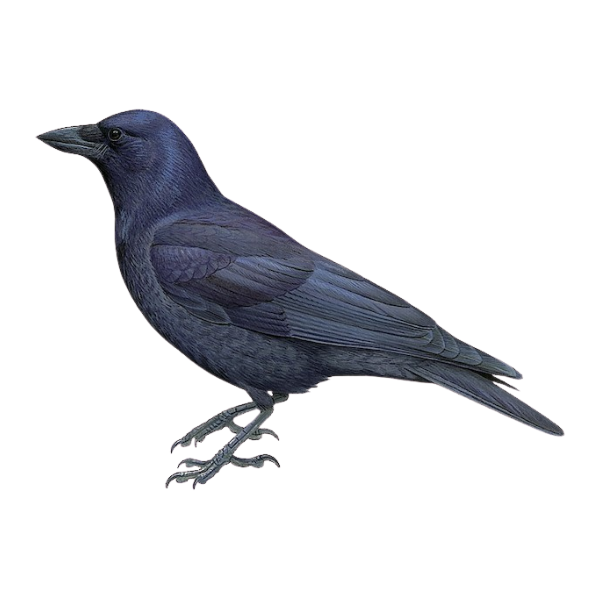
The White-necked Crow is a large Caribbean crow endemic to Hispaniola, the island shared by Haiti and the Dominican Republic. It is the largest of the four Caribbean crow species and depends on suitable forest habitat within its range. Habitat loss and historical hunting have contributed to its conservation concerns, and the species has disappeared from islands where it formerly occurred, including Puerto Rico and Saint Croix. Its restricted distribution makes habitat protection especially important.
Jamaican Crow
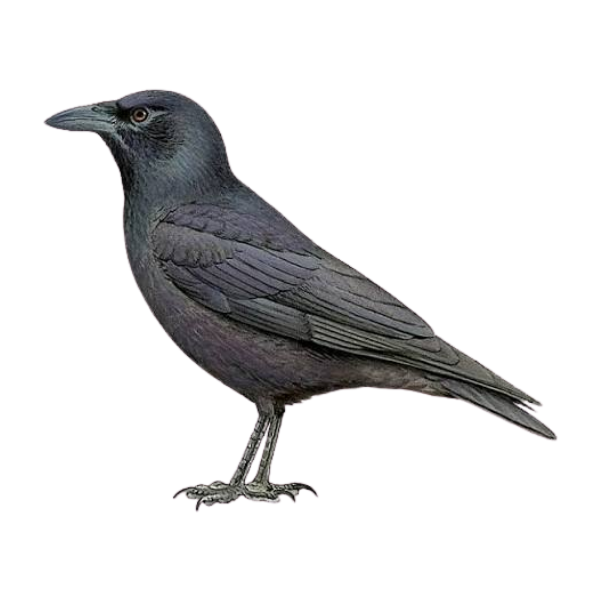
The Jamaican Crow is a relatively small crow found only on Jamaica. It reaches about 35–38 cm in length and shares several physical characteristics with other Caribbean crows, particularly the Cuban Crow and White-necked Crow. Its restricted island distribution makes it different from widespread continental species such as the American Crow.
Hawaiian Crow
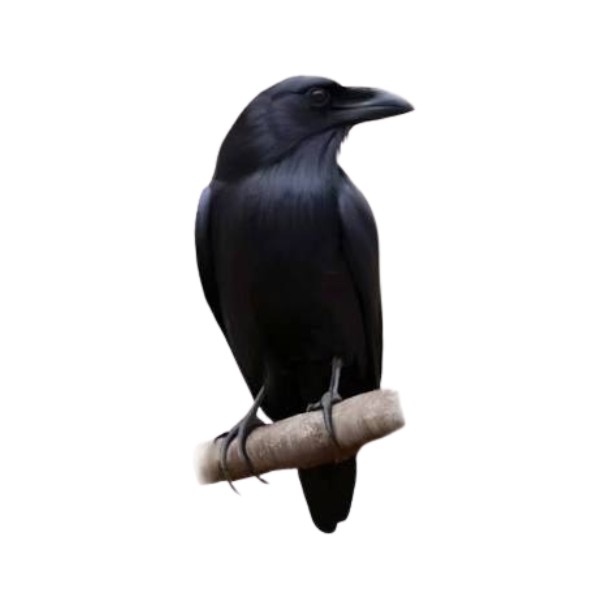
The Hawaiian Crow, known as ʻAlalā, is an endemic Hawaiian crow with an important ecological and cultural role. It is a medium-sized crow with dull black plumage, slightly brown-tinged wings, and distinctive throat feathers. The species has been extinct in the wild since 2002. Conservation organizations maintain captive populations and continue recovery work with the long-term goal of restoring the bird to suitable Hawaiian forests.
How to Identify a Crow Species?
I checked the current global bird-taxonomy context before writing this because “types of crow” is not a formal taxonomic category, and some crow names have changed treatment between bird checklists.
Crow Classification and Scientific Name
- Class: Aves
- Order: Passeriformes
- Family: Corvidae
- Genus: Corvus
How Many Types of Crow Are There?
There is no single permanent number that can be given for “types of crow.” The genus Corvus contains numerous recognized species, and the exact treatment can change when taxonomists split or combine populations.
For example, the former Northwestern Crow is now treated as a subspecies of the American Crow in the modern taxonomic treatment used by major global checklists.
What Do Crows Look Like?
- Medium to large body
- Strong, pointed bill
- Dark or black plumage in many species
- Strong legs and feet
- Rounded or squared tail
- Broad wings
- Distinctive cawing or croaking calls
Where Do Crows Live?
- Forests
- Open woodland
- Farmland
- Grassland
- Scrub
- Wetlands
- Coastal areas
- Islands
- Villages
- Towns
- Large cities
What Do Crows Eat?
- Insects
- Earthworms
- Seeds
- Grains
- Fruits
- Nuts
- Small animals
- Eggs
- Carrion
- Food scraps
- Other human-associated food
Crow Behavior and Intelligence
Crows are generally active, social, and adaptable birds. Some species form family groups or larger flocks, particularly outside the breeding season.
Their problem-solving abilities are especially interesting. The New Caledonian Crow is famous for using and manufacturing tools, while American and Fish Crows demonstrate flexible foraging and social behavior. However, intelligence should not be treated as identical across every crow species; different species have different ecological adaptations and levels of scientific study.
How Do Crows Reproduce?
Crow breeding behavior varies between species, but many crows build nests in trees or other elevated locations. Nests are commonly constructed from sticks and lined with finer materials.
American Crows have a particularly interesting family structure in which young birds can remain with their parents and help raise younger offspring. Fish Crows also build tree nests and have documented nestling periods lasting roughly 32–40 days.
Crow Size and Lifespan
Crow size varies substantially among species. The Little Crow is smaller than the Torresian Crow, while some larger crow species approach the size of smaller ravens. The American Crow is approximately 40–53 cm long, whereas the Little Crow is roughly 38–45 cm.
Lifespan also varies and should not be represented by one number for all crow species. For example, a wild American Crow has been recorded living for at least 17 years, but individual survival depends on disease, predators, food availability, habitat, and other environmental conditions.
Conservation of Crow Species
Crow conservation status differs greatly from one species to another. Several widespread crows remain common and are classified as Least Concern, while restricted island species can face much greater pressure.
The Hawaiian Crow is the clearest example in this guide: it has been extinct in the wild since 2002 and is the focus of an ongoing conservation and recovery program. The Slender-billed Crow, in contrast, has a very large range and is currently listed as Least Concern despite a decreasing population trend.
- Habitat loss
- Forest clearance
- Small geographic ranges
- Introduced predators
- Disease
- Human persecution
- Reduced food or nesting resources
Interesting Facts About Crows
- Crows and ravens belong to the genus Corvus.
- American Crows can live in extended family groups.
- Fish Crows are strongly associated with waterways in much of their range.
- House Crows have adapted especially well to human settlements.
- Hooded Crows have contrasting gray and black plumage.
- The New Caledonian Crow is well known for sophisticated tool use.
- Sinaloa and Tamaulipas Crows are separate Mexican species.
Frequently Asked Questions About Types of Crow
What are the main types of crow?
Well-known species include the American Crow, Fish Crow, House Crow, Carrion Crow, Hooded Crow, Large-billed Crow, Sinaloa Crow, Tamaulipas Crow, Pied Crow, Torresian Crow, Little Crow, New Caledonian Crow, White-necked Crow, Jamaican Crow, and Hawaiian Crow.
Are crows and ravens the same bird?
No. Crows and ravens are closely related members of Corvus, but they are different birds.
What is the most common type of crow?
There is no single crow species that is the most common worldwide. Different species are widespread and abundant in different regions.
Are all crows black?
No. Many crows are mostly black, but some have contrasting colors. The Hooded Crow has a gray body with black head and wings, while the Pied Crow has a prominent white neck and breast.
What do crows eat?
Crows are generally omnivorous. Depending on the species and habitat, they can eat insects, seeds, fruit, grains, small animals, eggs, carrion, and food discarded by people.
Animals related more articles